
Random Post: Starlight and Sufism
RSS .92| RSS 2.0| RSS 2.0| ATOM 0.3
  • Home/Blog
  • About
  • Events
  • Education
  • Inspiration
  • Mailing List
  • Contact
  •  

    Cookies and Chaos

    June 29th, 2010

    My teaching gigs have ended until fall so I’ve been busying myself composing and songwriting-for-hire. After months of obeying a firm academic schedule, setting my own hours again has been making me feel a bit random and chaotic. Which, of course, has been making me consider chaos theory…

    Chaologists have discovered a cool thing: seemingly random motions—turbulence in the air, water spiralling down a drain, etc.—are actually highly patterned. Processes that look unpredictable can thus be forcast, to an extent. It’s a comforting revelation. Look deeply enough into chaos and order emerges. There’s structure there. And when this kind of ordered chaos is plotted on a graph, it yields a beautiful shape called a Strange Attractor, which looks like this:


    Strange Attractor


    This graphic illustrates how chaotic systems behave: They loop again and again around a given point, never exactly repeating their route, but always staying bounded in orbit. Then, suddenly, they jump to another orbit around a different point! Ultimately, chaotic systems bounce between these two "attractors," looping around them in an infinite dance between yin and yang. Every cycle is different (hence, randomness) but bounded within a pattern (hence, order).

    In my professional life, music and spirituality/science are my two attractors—the points around which I orbit. And sometimes I need a break from both. Vacation! Even just one evening’s pit stop in the rat race around my Strange Attractor can set me right again.

    Last night I decided to take an at-home vacation. I turned off the phone, disconnected from the internet, and rummaged through the pantry in search of cookies. And in the very back of the cabinet I found… Palmiers.

    Unbelievable.

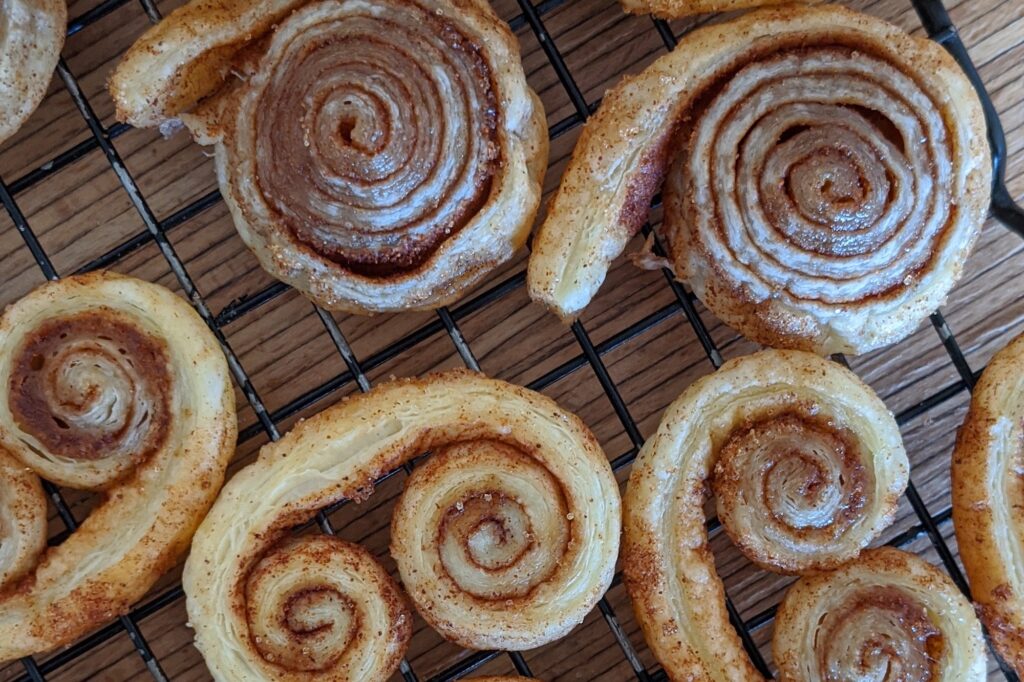
    Palmiers are pieces of puff pastry folded over themselves a bunch of times, sprinkled with sugar, and baked until golden. They look like this:


    Palmier


    They’re Strange Attractors!

    And so my vacation ended prematurely, as I felt compelled to write this blog. Resistance is futile?! May as well enjoy the loopy ride.

    So now I’m back to work and wondering… What are your attractors—around which points do you orbit?

    Comments welcome.

    Add a comment »

    Bookmark and Share

    Tags:


    Thin Places

    May 23rd, 2010

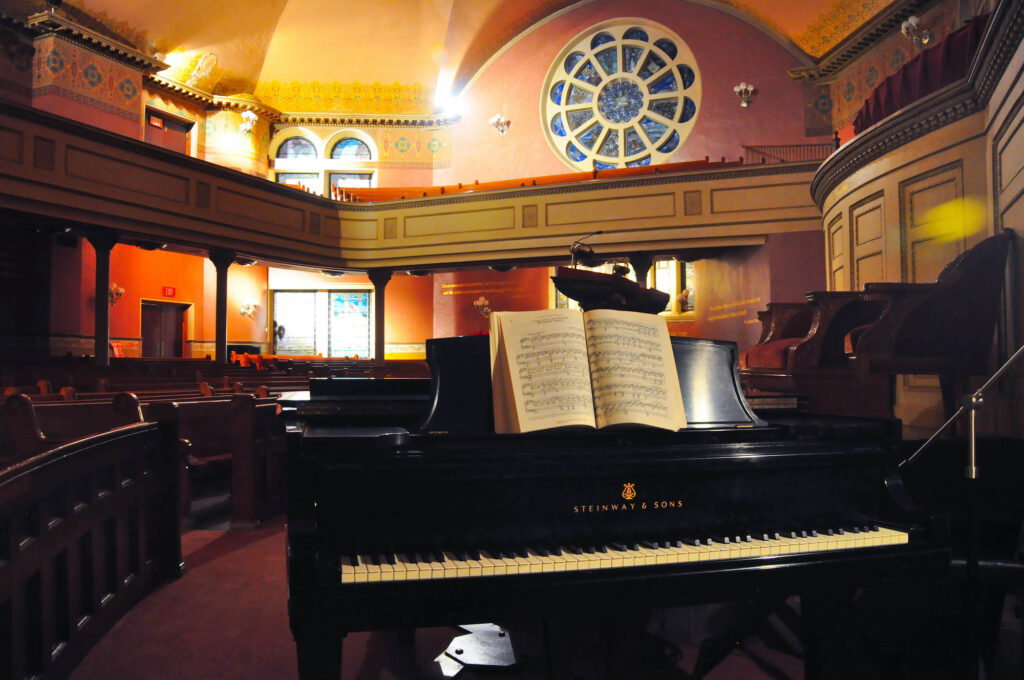
    Last week I was touring the East Coast playing music—my career when I’m not writing Poetic Interconnections. One of my shows was at a church in Dover, DE. The chapel was beautiful: stained glass, vaulted ceilings, dark wood pews. And the acoustics in the space were ideal; the natural reverb was lush and gorgeous.

    Down the center aisle was a Steinway full grand piano, perfectly tuned and balanced. I sat and played an hour before my gig, reveling in the vibrations, resonant and lovely. During my set, I sang Leonard Cohen’s "Hallelujah" in that ambient sanctuary and I literally felt God. It may have been my most sublime artistic moment.


    Wesley


    Since that evening, I’ve been thinking a lot about sacred spaces. Churches, temples, and shrines all seem to have the same effect on me: as soon as I step inside I feel reverent, humble, and inspired.

    What is it about these places that moves me this way? What residue lingers in the air after years of prayer and devotion, hallowing a physical space, making it what Celtic Christians used to call a "thin place," an area where the barrier between the secular and sacred becomes permeable?

    What makes a place tangibly holy, and could there even be a scientific explanation for it?

    Turns out, there may be.

    Some quantum physicists believe we move in a field of subtle energy, much like fish swim in water. This energy sea underlies our physical universe; it’s so fundamental we can only perceive it indirectly. The implications are intriguing… Imagine a ship on the ocean; it leaves waves behind as it travels. For as long as these waves churn before they dissipate, the surface of the sea becomes a recording of the ship’s presence and motion. Analyzing the wave patterns we can tell where the ship was, what direction it was moving, and possibly even how massive it is.

    The energy sea in which we live is like an ocean, except unlike water, physicists theorize it’s superfluid. This means it’s a medium with no viscosity, no friction, so waves moving within it never dissipate! The field of energy in which we live may thus be a permanent recording of universal events. The cosmos may literally have a memory.

    So what does this have to do with thin places? Like any activity, religious ritual surely makes waves in the energy field underlying a sacred sight. Maybe years of repeated reverence cause more and more waves to layer and interweave into a thick tapestry of spiritually-inspired quantum energy. And maybe this energy, when repitition makes it grow sufficiently dense, becomes physically perceivable, if only subtly.

    If this is true, I wonder if repeated events in any location cause it to become full with energetic memories. Perhaps thin places don’t have to be only spiritual. They could also be secular: childhood bedrooms, beloved gardens, concert stages, etc.

    Do you have a thin place—somewhere you feel timeless, connected to powers greater than yourself?

    Comments welcome.

    Add a comment »

    Bookmark and Share

    Tags: ,


    Art, Faith, and Discovery

    April 17th, 2010

    I recently found this quote by Albert Camus, author of the literary classic The Stranger: "A man’s work is nothing but this slow trek to rediscover, through the detours of art, those two or three great and simple images in whose presence his heart first opened."

    Camus’ sentiment is lovely, describing the creative process as a journey back to the feeling of aesthetic awakening. The idea reminds me of one of my favorite passages written by Jewish mystic Abraham Joshua Heschel, redefining faith:

    In every man’s life there are moments when there is a lifting of the veil at the horizon of the known, opening a sight of the eternal… The remembrance of that experience and the loyalty to the response of that moment are the forces that sustain our faith. In this sense, faith is faithfulness, loyalty to an event, loyalty to our response.

    Every world religion describes a state of original bliss from which we’ve fallen, and each promises a path to reclaim that feeling. It seems to me that Camus and Heschel are both riffing on this theme. Camus’ trek is the pursuit of art; Heschel’s path is the practice of memory.

    Science offers its own variation on this theme. The Large Hadron Collider at CERN was built to crash beams of subatomic particles together at near light speeds, attempting to recreate the energy levels exhibited by our universe just after the Big Bang. At these energy levels, the four fundamental forces—gravity, electromagnetism, and the strong and weak nuclear forces—may have been fused into a single, symmetric "superforce." Physicists think it was only as our universe cooled that this force’s symmetry broke, allowing the distinct forces we’ve since discovered to separate and clarify.

    The symmetric state in which our universe’s forces were unified is an interesting analogue to Camus’ heart-opening images and Heschel’s "lifting of the veil". Our cosmos was newborn, energetic, and rich with potential. It’s no wonder physicists are driven to recreate the situation; the possibilities for discovery are thrilling!


    Large Hadron Collider at CERN


    We all have perennial experiences that shake us awake, stir us with grandeur, and change us forever. We become seekers the rest of our lives, always trying to get back to the perfection of those first revelations.

    Mine was musical: "The Warmth of the Sun" by The Beach Boys. Brian Wilson’s falsetto floating above his family’s rich harmonies has influenced everything I’ve created since. I’m always trying to reproduce the lush beauty of that recording and how it made me feel, whether I’m recording music, writing prose, or designing visual art.

    What was your first revelation?

    Add a comment »

    Bookmark and Share

    Tags: , ,


    From Zero to Infinity

    March 20th, 2010

    Last week I was honored and thrilled to introduce my Spirituality, Science, and the Creative Process students to two stellar visual artists from Los Angeles, CA: Victor Raphael and Clayton Spada.

    Generously donating their time, Victor and Clayton came to class to show and discuss their ongoing collaborative series, "From Zero to Infinity". All these artworks juxtapose spiritual and scientific images in a beautiful, resonant way. To me, they’re poetic interconnections rendered visually.

    I’m an unabashed fan.

    My students were also excited by the series, encouraging me to introduce you to "From Zero to Infinity". Here are a few of the artworks:


    Genesis

    This piece is called Genesis. The scripture is from the first chapter of the Torah, detailing God’s creation of the physical world. The lines and swirls interlaced with the Hebrew text are bubble chamber tracks: images of elementary particles being created in high-speed collisions. To me, the artwork is a meditation on creation at its most fundamental, unitive level.


    Odyssey

    This piece is called Odyssey. It layers images of ancient cave paintings with equations handwritten by Albert Einstein, commenting on the evolving ways humans have communicated their conceptions about the nature of their world throughout the ages.


    Emanations

    Finally, this piece is called Emanations. It features the Japanese Goddess Quanwon, whose energy field is thought to bring health and happiness to her worshippers. Juxtaposed is an artistic depiction of the Cosmic Microwave Background Radiation—the sea of energy pervading our universe, left over from the Big Bang.

    "From Zero to Infinity" was on display at USC’s Doheny Memorial Library this past fall. To see more prints from the series, please visit Victor’s website and/or the USC Libraries webpage for the exhibit.

    And if these artworks enchant you as they’ve enchanted me, please spread the word about them! Forward this blog post to anyone you know who might be equally captivated.

    My sincere thanks to Victor Raphael and Clayton Spada for their time, their art, and their vision.

    Comments, of course, welcome…

    Add a comment »

    Bookmark and Share

    Tags: , , , ,


    The Angel and the Uncarved Block

    February 18th, 2010


    Michelangelo's angel


    As February speeds by, I’m a few weeks into teaching my first full-length class: Spirituality, Science, and the Creative Process at Otis College of Art and Design. I’m blessed with a tight group of intelligent, engaged students, so I’m having a great time. And interweaving art and creativity into my poetic interconnections between spirituality and science is revealing itself to be an inspiring exercise.

    Researching material for our first session, I found a famous quote by Michelangelo that, somehow, I’d never heard before. Explaining one of his most famous sculptures, the artist said, "I saw the angel in the marble and carved until I set him free."

    My mind fairly quickly derailed. I thought immediately about p’u—the Taoist ideal of the uncarved block.

    In Chinese philosophy, our most natural state of being is simple and undefined. Before experiences and judgments introduce distinctions such as good/bad, right/wrong, and even me/you into our thinking, we all enter the world as blank canvases. We have no fixed mental forms and thus infinite potential for becoming. This state of being is highly desirable, as it mimics the tao—the sacred Way of the universe. So in Taoism, p’u is the goal of life.

    About.com describes this ideal beautifully as "perception without prejudice".

    Physics describes a similar condition, calling it symmetry. An oft-cited example of this is a pencil balanced on its tip. For the briefest of instants, the pencil has no preferred direction for falling. Its possibilities are equal, therefore symmetrical. But as soon as the pencil tips one way or the other its symmetry is broken. Infinite potential yields one actualized outcome. It’s both a triumph and a tragedy.

    Physicists believe that right after the Big Bang our earliest universe was highly symmetrical: matter, light, and the fundamental forces (gravity, electromagnetism, etc.) were indistinguishable. Only with time did differentiation enter our universe, as the energy from its explosive birth calmed and cooled and light clarified from dust, matter decoupled from force.

    Our universe, too, began as a blank canvas.

    Michelangelo made a miracle: he actualized the potential in the marble, breaking its symmetry in an act of loving creation. A Western mystic might say he imitated God. I believe creative artists channel divinity every time they sit to work. I’m teaching this idea in class. In doing so, though, I realize I’m betraying some of my source material. Eastern spiritual traditions believe differentiated creation is illusory and a source of suffering, advocating a return to a state of unrealized potential so pure it precludes rebirth into the world.

    And so an interesting question presents itself: Is God the slab of marble or the angel Michelangelo revealed inside? Is divinity the Taoist uncarved block or the forms we recognize as ourselves? Is our ideal condition perfectly symmetrical or the broken symmetry necessary for creation?

    Comments welcome.

    Add a comment »

    Bookmark and Share

    Tags: , ,


    Reminder: Spirituality, Science, and the Creative Process

    January 29th, 2010


    Spirituality, Science, and the Creative Process


    A reminder… My first full-length course exploring spirituality/science begins tomorrow! Spirituality, Science, and the Creative Process will be presented by the Continuing Education program at Otis College of Art and Design in Los Angeles, CA, and enrollment is still open to the public.

    Here’s a course description:

    Great ideas inspire enduring art. This course explores the grand themes shared by spiritual philosophy and cutting-edge science, using them as source material for artistic creativity. Examining energy, duality, infinity, chaos, evolution, and actualization, students write reflective journals each week about how these and other spiritual and scientific themes can be applied to their creative process, inspiring resonant artwork in any medium. Special presentations by artist Marcie Kaufman highlight the work of visual artists inspired by both spirituality and science, and a hands-on workshop mid-course guides students in enacting and illustrating some of the grand themes discussed in class.

    The course runs 10 weeks, Saturday mornings, starting tomorrow, and will include and expand upon all your favorite poetic interconnections between spirituality and science. And Marcie Kaufman, my co-conspirator for the term, is brilliant and engaging, and her mid-course workshop is sure to be deep, enlightening fun.

    Here’s a link to enroll in the class:

    http://www.otis.edu/ce,course.php?crs=539&sem=25

    Looking forward to seeing you there!

    Add a comment »

    Bookmark and Share

    Tags: ,


    A Superfluid New Year, Reprise

    January 2nd, 2010

    Last New Year’s Day I wrote a heartfelt blog post exploring a poetic interconnection among Taoism, physics, and the turning of the year. Today I feel inspired to reprise that essay, slightly revised, for those of you who’ve joined me in 2009… This one’s for you!

    I love Chinese philosophy—its naturalness, its easy wisdom.

    I’m in good company: Taoism may be the most popularized religious mysticism in the world. Books about any variety of topics have the phrase “The Tao of…” in their titles. A quick search at Amazon yields The Tao of Healing, The Tao of Eating, The Tao of Photography, and even The Tao of Network Security Monitoring! And in contemporary America, the Chinese words yin and yang have become cultural fall-back terms for the idea of interdependent opposites. They’re part of the pop lexicon.

    A key Taoist concept that’s less widely known is wu wei. This Chinese term is perhaps best translated as “effortless doing”. The paradoxical phrase describes an orientation of self-surrender to the tao—the all-encompassing Way of the natural universe. Essentially, wu wei is pure acceptance of the process of life and the sacred rightness of every moment. It’s about moving in the world by flowing with it.

    Religious scholar Huston Smith, in his seminal book The World’s Religions: Our Great Wisdom Traditions, summarizes the idea this way:

    Action in the mode of wu wei is action in which friction—in interpersonal relationships, in intra-psychic conflict, and in relation to nature—is reduced to a minimum.

    In physics, a superfluid is a phase of matter in which viscosity is zero. Viscosity is a term that describes a liquid’s resistance to flow, or disturbance by other substances. A thin liquid like water has low viscosity: it flows quick and easy and other substances move through it without much bother, their speed only slightly effected. A thick liquid like honey has high viscosity: it flows slow and sluggish and other substances struggle to move through it, becoming seriously held up as they try.

    Viscosity, then, is a measure of a liquid’s friction.

    In a superfluid, there’s basically no friction at all. This means a superfluid flows infinitely smooth, and things move within it resistance-free. So anything in motion inside a superfluid stays in motion, theoretically, forever. With no friction to slow or stop it, a process inside a superfluid unfolds unendingly!

    A superfluid strikes me as an interesting analogy for the tao. And the quality of superfluidity is such a cool metaphor for wu wei.

    So… Today commences a new calendar year: it’s 2010! This blog post is a benediction: May we all have a superfluid new year, characterized by the utmost wu wei—with friction within and among us reduced to a minimum, our lives flowing infinitely smooth, and our happinesses unending.

    Thank you for your readership! Love and blessings to you.

    Add a comment »

    Bookmark and Share

    Tags: ,


    God Is a Deep Fryer, and Happy Holidays!

    December 13th, 2009

    This December marks my second holiday season writing Poetic Interconnections: Exploring Spirituality and Science. Looking back over 2009, it’s very clearly been a year of bounty and blossoming for me. Many of you reading this blog post were attendees at my first lectures and workshops. I met others of you during my presentation at the Science and Nonduality Conference in San Rafael, CA. And some of you discovered this blog solely over the internet, querying Google with unlikely combinations of religion/science terms and finding me! All year, I’ve been honored and touched by your thoughtful participation and enthusiastic support. Thank you!

    Though I study and celebrate all world religions, my own background is Jewish. So as I sit to write a holiday-themed blog post, I have Chanukah on my mind… Like many Jews, one of my primary associations with the occasion is food. For me, Chanukah isn’t so much a festival of lights as of latkes—the fried potato pancakes customary to the holiday meal. Accordingly, I offer you this quick, silly poetic interconnection between spirituality and science, in honor of Chanukah:

    Many of us love latkes, but few of us realize their spiritual implications. The process of frying can be a metaphor for redemption. When we heat oil, its molecules accelerate, raising its vibrational energy. While frying, excess water and impurities from our latkes purge into the oil. The resulting cake is crisp and clean.

    Imagine the heated oil as God, and a latke as you. Surrender yourself to frying, immersing yourself in a higher vibrational energy, and feel your tears and vices be absorbed and absolved. You’ll emerge from the pan purified.


    latke


    Happy Holidays! Peace and blessings to you.

    Add a comment »

    Bookmark and Share

    Tags:


    Spirituality, Science, and the Creative Process

    November 23rd, 2009


    Spirituality, Science, and the Creative Process


    I’m thrilled to share with you that starting in January 2010, I’ll be teaching a course in Los Angeles, CA called Spirituality, Science, and the Creative Process. The course will be presented by the Continuing Education program at Otis College of Art and Design, and enrollment is open to the public!

    Here’s a description of the course:

    Great ideas inspire enduring art. This course explores the grand themes shared by spiritual philosophy and cutting-edge science, using them as source material for artistic creativity. Examining energy, duality, infinity, chaos, evolution, and actualization, students write reflective journals each week about how these and other spiritual and scientific themes can be applied to their creative process, inspiring resonant artwork in any medium. Special presentations by artist Marcie Kaufman highlight the work of visual artists inspired by both spirituality and science, and a hands-on workshop mid-course guides students in enacting and illustrating some of the grand themes discussed in class.

    The course runs 10 weeks, Saturday mornings, and will include and expand upon all your favorite poetic interconnections between spirituality and science. And Marcie Kaufman, my co-conspirator for the term, is brilliant and engaging, and her mid-course workshop is sure to be deep, enlightening fun.

    Here’s a link to enroll in the class:

    http://www.otis.edu/ce,course.php?crs=539&sem=25

    Looking forward to seeing you there!

    Add a comment »

    Bookmark and Share

    Tags: ,


    Death & Sex

    November 5th, 2009


    Death & Sex


    Back in July I was asked to contribute a review blurb to an upcoming book called Death & Sex. The request came from Dorion Sagan, one of the book’s authors—an amazing writer and a friend of this blog. I immediately said yes. I was sent an advance copy of the text and spent the next few evenings unable to put it down, rapt.

    The book is a hybrid: two essays by different authors bound into a single work. Tyler Volk’s Death examines how our passing feeds the greater cycle of life, our bodies breaking down into food and energy for other animals and plants. Our greatest personal fear is thus recast as an ecological act of self-sacrificial love. It’s a deeply spiritual view of dying.

    Dorion Sagan’s Sex suggests that our procreating has cosmic implications. We reproduce to continue life. And viewed from the perspective of thermodynamics, life on Earth actually exists to help spread the concentrated energy of our sun into surrounding space. Nature likes its energies evenly distributed, and we ease an inequity: we take in localized sunlight and disperse it into space as heat.

    Simply by living we’re doing God’s work, spreading the good solar news.

    Death & Sex is out now, and my review blurb is printed inside. This blog post is to thank Dorion Sagan and Chelsea Green Publishing for the honor and pleasure, and to turn you on to a fine, fascinating read.

    If you pick it up, let me know… Comments always welcome.

    Add a comment »

    Bookmark and Share

    Tags: